

Section I7
( Historic traverse )
I7 – Stracin- Kapinovo- 189.6km
Section I7, the Historic Traverse, is one of the most archaeologically and historically rich sections of the entire Macedonian Endless Trail. Along its almost 190 km, the route links an unusual concentration of ancient sites with many active Orthodox monasteries.
Beginning at the highway pass near Stracin and finishing at the depopulated village of Kapinovo (the geographic center of the entire Macedonian Endless Trail), the trail crosses the Kriva Reka valley, the wild Bislim Gorge, the Pčinja and Vardar river canyons, and the southern slopes of Jakupica before descending into the heart of the country. It is a section defined by high peaks in the west and density of history hidden in its forests, rocks, and river valleys to the east.

Trail Closures and Updates ( Last updated: September 2026 )
- Wildfires on Section I7 – Two separate wildfires during August affected the following areas:
-between #I7-6340 and #I7-6580 , between #I7-8090 and #I7-8180
We do not expect major damage to the trail. However, these areas are closed until we can assess conditions on the ground. We expect the assessment to take place in late September – October this fall.
Trail Overview
| Total Distance | 189.6 km (117.8 miles) |
| Estimated Hiking Time | 7-11 days |
| Difficulty | Moderate to Strenuous |
| Highest Point | 1900m. Peak Kale at 2112m is accessible via a side trail |
| Trail Marking | Mostly marked (GPS recommended for some sections) |
| Best Season | April-June, September-November |
| Trail type | Mostly mountain paths and forest roads, some dirt roads, less than 1% paved road |
| Backpacking type | Wild camping |
Section Highlights
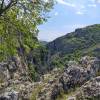
- Kuklice “Stone Dolls” rock formations
- Cocev Kamen – ancient carved rock sanctuary with a natural “throne” chamber
- Konjuh – ancient rooms and terraces carved into the cliffs, near the Golemo Gradiste archaeological site
- Beljakovski Monastery (St. George)
- Gabres Monastery, Skackovce Monastery , Gjuriski Monastery
- Bislim Gorge
- Cave church of St. Bogorodica, reached via two consecutive suspension bridges over the Pchinja and Vardar rivers
- Old military bunkers along the Crn Vrv ridge
Elevation profile:

Google Map
Gallery




Essential Planning Information
Best Time to Visit
Section I7 is best hiked April through June and September through November. Spring brings full flow to the fountains and springs and comfortable temperatures at lower grounds where summer brings hot and scarce water situation. Autumn offers stable weather and is an excellent time to visit the monasteries along the route. Early spring and winter hiking is possible on the lower segments but Jakupica massif and the higher ridges can hold snow and ice.
Water Sources and resupply
Section I7 is unusually well-supplied with water compared to other East Wing sections – the GPS track marks dozens of fountains, wells, and springs across nearly every segment, many at monasteries or old village sites. However, several wells hold stagnant water and require filtering, and a few fountains dry up in summer, so check the notes attached to each point on the GPS track before relying on it.
Villages along the route – Stracin, Pchinja and Skachkovce – generally offer basic supplies. The trail crosses several asphalt roads where a short hitch reaches a larger town for full resupply. Plan to carry 3-4 days of food between the more substantial resupply points.
Accommodation
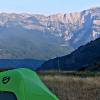
There are no mountain huts on Section I7. Wild camping is the primary option, and the GPS track marks an exceptionally high number of camp spots – many with views, water nearby, or natural shelter under rock overhangs and in small caves. Several monasteries along the way may offer basic pilgrim lodging. Wild camping should follow Leave No Trace principles throughout.
Cultural & Historical Sites
True to its name, the Historic Traverse passes an unusual concentration of historical and archaeological sites: the ancient rock sanctuary of Cocev Kamen, the carved cliff chambers of Konjuh, the Golemo Gradiste ruins, the medieval Castle of Pchinja, old military bunkers, and six active Orthodox monasteries. Treat archaeological remains with care – do not climb on or otherwise alter the carved rock chambers. At the monasteries, dress modestly (covered shoulders and knees), keep quiet and respectful. Ask permission before photographing inside a church.
Wildlife & Environment
The forests along Section I7 host bears, wolves, wild boar, foxes, jackals, and deer. Vipers are present in the rocky terrain around Cocev Kamen, Kuklice, and the Kriva Reka canyon — watch where you place your hands and feet when scrambling near rocks.
GPS track:
The gps track for section I7 (Historic Traverse) contains all waypoints, markers, points of interest photos, and digital elevation data
Download the complete GPS track ( English version 23.09.2026) :
KML format for this section HERE
GPX format for this section HERE
For explanations of marker meanings, trail types, and coding used in the GPS files, consult the technical information page HERE
Detailed Segment Descriptions
Section I7 is divided into five distinct segments, each centered on a different chapter of the region’s history.
Segment 1: Stracin to Beljakovce
Distance: ~26.5 km
Difficulty: Moderate
Segment 1 is the archaeological showcase of the whole trail – barely any elevation change, but an unusual concentration of ancient sites in less than 30km of trail.
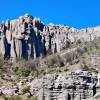
The trail starts on the highway E871 (Kumanovo–Kriva Palanka), at the pass near the village of Stracin. It begins on a narrow paved road that quickly turns into a dirt forest road for the first 2 km, then continues on a mountain trail that offers open views all the way to the foot of Peak Kalugjerica. From there it descends slowly through the short canyon of the Kuklichka River to the famous locality of Kuklice (the “stone dolls,” 50 m below the trail). The trail continues through “Golemo Kuklice,” a lesser-known but even more impressive area of larger rock formations, briefly rejoins a dirt road, and crosses the hill of Krtichno down to the Kriva Reka valley.
After a pedestrian bridge over the Kriva Reka, the trail passes below the rocky site of Kraljica, through Svinski Kamen, to the historic site of Cocev Kamen – an ancient rock sanctuary dating back to the Bronze Age . The route continues through the historic site of Konjuh, where ancient rooms and terraces carved into the cliff face sit above the archaeological site of Golemo Gradiste. It then passes beneath the rocky spikes of Kaliman through the wide Kriva Reka valley to the bridge at Beljakovce.
This segment has no major elevation changes – the highest point is 810 m – and is rich in rock formations and ancient sites shaped or repurposed over centuries as dwellings and sanctuaries. Budget extra time to explore Cocev Kamen and Konjuh properly.
Trail Status: Not much way markings on this segment, but the route is easy to follow with the GPS track. Most of the walking is on narrow paths that occasionally meet quiet dirt roads not used by trucks or off-road vehicles.
Segment 2: Beljakovce to Pchinja village
Distance: ~49.3 km
Difficulty: Moderate to Strenuous
From near the Kriva Reka bridge at Beljakovce, the trail climbs the rocky Elenec hill to the beautiful old Beljakovski Monastery (St. George), then continues climbing through quiet, unpopulated hill country, with wide views eventually opening over the Kumanovo plain. Despite passing close to several villages, the trail feels remote throughout. It descends near K’sanje village to cross the Kumanovo–Sv. Nikole highway.
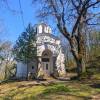
From the highway, the trail climbs through deciduous forest on a forest road, then a narrower mountain path, up to the church of St. George. Shortly after, it crests an unnamed peak above the monastery and descends through forest to the Gabreš Monastery (St. Petka), above the village of the same name. It continues through more forested hill country to the Skačkovski Monastery (St. Troica), above Skačkovce village, before turning slowly toward the beautiful Bislim Gorge.
The trail descends into Bislim Gorge — a narrow limestone canyon long surrounded by local legends of caves hiding cursed, buried treasure. Along the way it passes several caves, and rock features known as Little and Big “Eye,” before ending at the outskirts of Pchinja village.
Trail Status: Around half of this stretch is waymarked, so GPS remains necessary throughout.
Segment 3: Pchinja village to Kastel
Distance: ~48.9 km
Difficulty: Moderate
Segment 3 is the calmest stretch of I7 – long, easy , with little drama until the final descent to the river Pchinja gorge.
From Pchinja village, the trail winds first through evergreen forest, then deciduous woodland, crossing a couple of minor ridges and a small stream gorge on mostly wide forest roads, with narrower mountain trail mixed in here and there. It climbs to the Gjuriški Monastery and Gjurishte Peak, dips and climbs again over Crn Vrv, passing several old bunkers left over from the former Yugoslav People’s Army (JNA). From there the trail descends slowly to the Pchinja River gorge, immediately below the Castle of Pchinja locality.
Along this segment mixed mountain trails and wider forest roads alternate, with the mountain trails prevailing overall.
Trail Status: The route is mostly waymarked and the trail clear, except at the first crossing beneath the Goce Delcev highway, where more frequent GPS checks are useful.
Segment 4: Kastel to Breza
Distance: ~22 km
Difficulty: Moderate to Strenuous
Segment 4 is short but intense: the most dramatic river scenery on I7, crossed via two adrenaline-inducing suspension bridges.
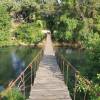
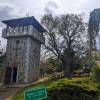
The trail begins immediately below Castle of Pchinja – known in the Middle Ages as the fortified town of Kozle, and before that as a late-antique castellum guarding the Roman-era road between Thessaloniki and Skopje – descending to the bank of the Pchinja River. It follows the riverbank through a strikingly beautiful, at times dramatic gorge to the cave church of St. Bogorodica, where the first suspension bridge crosses the river. Shortly after, a second, larger suspension bridge crosses the Vardar River and a railway line, and the trail begins climbing Golesh Mountain. It reaches the Monastery of St. Ilija first, then the old rural village of Karabunishte, from where it continues over the Iliica ridge toward Peak Breza (1,405 m).
Trail Status: The trail is fully waymarked but do not expect a well trodden path all the way
Segment 5: Breza to Kapinovo
Distance: ~42.9 km
Difficulty: Moderate to Strenuous
Segment 5 reaches the highest point of the entire section and keeps a near-alpine character along the Jakupica range for much of its length – open ridgelines and big views with occasional old deciduous forests .
From Peak Breza, the trail descends along an open ridge lined with beautiful camping spots and sweeping 360-degree views, gradually descending to the asphalt at the Topolka River bridge. From here it climbs back up from around 500 m, crossing the Lukovo Pole plateau beneath Peak Prerok, before curving south at the foot of Peak Bel Kamen.
The trail then continues along the southern side of the mountain beneath Peak Kale and through the area of Begovi Virovi where arguably are the best views of the whole section I7. From here it begins its final descent toward the Monastery of St. Petar i Pavle and the village of Creshnevo, before reaching the center of the entire Macedonian Endless Trail at Kapinovo.
Trail Status: The trail is almost fully waymarked. Descending towards the St Petar i Pavle monastery the trail at times asks for more attention as it’s a narrow sometimes steep and exposed trail.
Experience the Journey
Section I7 rewards hikers as much with history as with landscape. Few long-distance trails anywhere link an ancient rock sanctuary, cliff dwellings, a medieval castle, six working monasteries, and a stone forest of natural rock “dolls” within a single week of walking. The dense network of fountains, springs, and camp spots makes this one of the more forgiving sections of the East Wing.
From the depopulated silence of Kapinovo – the geographic heart of the entire Macedonian Endless Trail – back to the highway pass above Stracin, Section I7 traces a line through layers of nature and history rarely seen together on foot.
Enjoy hiking – Leave only footprints – Take only photographs